
Legal Validity of Electronic Transport Documents in International Trade
As electronic commerce expands and intelligent systems become more common in freight transportation, paper-based documents are gradually being replaced by digital alternatives. Electronic bills of lading, international consignment notes, information recorded in transportation management systems, and other digital documents relating to the movement of goods have simplified shipment documentation and tracking procedures. Nevertheless, an important question for cargo owners, transportation companies, drivers, and international trade professionals concerns the extent to which electronic transport documents are legally valid and whether they may be relied upon as evidence in the event of a dispute.
Under Iranian law, a document’s electronic format does not, by itself, render it legally invalid. The Iranian Electronic Commerce Law recognizes the evidentiary value of data messages, while transportation regulations also provide for the issuance and use of electronic transport documents in certain circumstances. However, each document’s validity depends on its nature, issuance method, issuing authority, the ability to verify the information’s authenticity, and the specific regulations governing the relevant transportation operation.
This article examines the legal foundations of electronic transport documents, the conditions under which they may be relied upon as evidence, the distinction between electronically issued bills of lading and scanned copies of paper documents, and the principal considerations arising in the event of a dispute.
What Are Electronic Transport Documents and What Are Their Functions?
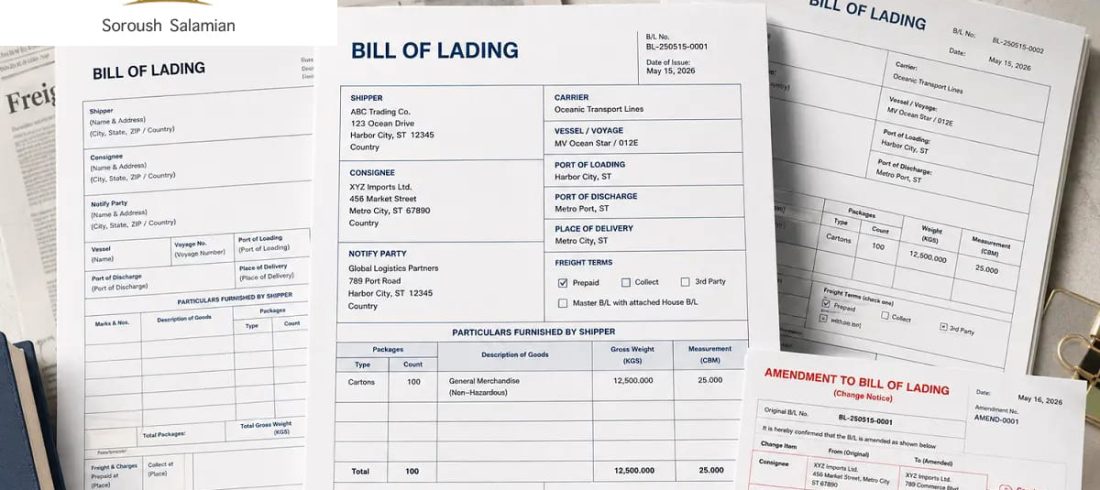
Electronic transport documents are records that store information relating to contracts of carriage, descriptions of goods, consignors, consignees, carriers, vehicles, origins, destinations, and other relevant transportation details in digital form. Transportation companies may issue these documents through official transportation systems or software platforms. They identify shipments, monitor transportation operations, and establish information about the carriage of goods.
Examples include domestic electronic bills of lading, electronic international road consignment notes (including electronic CMR consignment notes), and other digital documents associated with freight transportation. Regulations governing Iran’s Comprehensive Transportation System also emphasize digitizing documents such as domestic bills of lading and international CMR consignment notes, along with the ability to verify their information electronically.
These documents extend beyond reducing errors from manual data entry by facilitating access to historical records, accelerating verification procedures, and improving access to transportation information. Where disputes arise concerning the characteristics of goods, the date of issuance, or the responsibilities of the parties involved, electronically recorded information may play an important role in establishing the relevant facts.
However, a distinction must be made between an electronic transport document issued through a reliable system and a file that merely contains an image or scanned copy of an existing document. Both may be examined as evidence, but the procedures required to establish their authenticity and their respective degrees of evidentiary reliability are not necessarily identical.
Legal Basis for the Validity of Electronic Transport Documents in Iran
One of the principal legal foundations for recognizing electronic documents under Iranian law is the Electronic Commerce Law of 2003 (1382 in the Iranian calendar). Article 12 provides that documents and evidence used in legal proceedings may take the form of data messages and that their evidentiary value cannot be rejected solely because they exist in electronic form. Accordingly, a document’s digital nature does not, by itself, prevent its examination or admission as evidence.
Article 13 of the same law links the evidentiary value of data messages to several factors, including the reliability of the security methods employed. Under Article 14, data messages generated and maintained through secure procedures are recognized as valid and admissible documents before judicial and legal authorities with respect to their contents, associated signatures, and relevant obligations.
Specific transportation regulations are also significant. For example, Article 12 of the Executive Regulations implementing Articles 5 and 6 of the Law on Combating Smuggling of Goods and Foreign Currency provides for the digitization of certain transport documents, including domestic bills of lading and international CMR consignment notes, and their replacement of physical documents under applicable laws and regulations.
Consequently, the legal validity of electronic transport documents must be examined within two regulatory frameworks: the general provisions governing electronic commerce and the specific regulations applicable to the relevant document and mode of transportation. Determining a document’s legal status requires examining the regulations currently in force and the requirements established by the issuing system.

What Conditions Are Important for the Legal Validity of Electronic Transport Documents?
The mere presence of transportation information in a digital file is insufficient to establish its full legal validity. Assessing a document requires examining how the information was generated, who recorded it, and whether its authenticity and historical records can be verified.
One important criterion is the ability to attribute the document to its issuer or the responsible parties. Information should be recorded in a manner that makes it possible to establish its connection to the transportation company, consignor, driver, or other relevant individuals. Verified user accounts, electronic signatures, unique identification numbers, and identity authentication mechanisms may assist in this process. However, the specific requirements depend on the regulations governing the document.
Another essential criterion is data integrity. It should be possible to determine whether the recorded information has been modified after the document was issued. Date and time records, amendment and cancellation histories, and verification through the issuing system can help assess whether the information has remained unchanged.
Accessibility and the ability to retrieve the document when required are also important. When information is stored exclusively on a single device, and there is no reliable way to establish its origin or retrieve supporting records, evaluating its evidentiary reliability may become more difficult.
Finally, the requirements for legal validity are not identical for all transport documents. For example, a document issued through an official transportation system may be subject to specific requirements that do not apply to a file transmitted through a messaging application.
Evidentiary Value of Electronic Transport Documents in Court
The evidentiary value of electronic transport documents concerns whether the information they contain may be used to establish a fact, obligation, or legal relationship during dispute resolution proceedings. Under Iranian law, the general answer is affirmative. However, the degree of reliability attributed to a particular document depends on the circumstances of its creation, preservation, and authentication.
Under Article 12 of the Electronic Commerce Law, a court or government authority cannot disregard the evidentiary value of a data message solely because of its electronic format. Article 13 further emphasizes the importance of evaluating factors that establish reliability. Accordingly, when examining an electronic bill of lading, relevant considerations may include the document’s identification number, information recorded in the electronic system, issuance history, the issuer’s identity, and its relationship to other transportation records.
For example, where a dispute arises over a shipment’s characteristics or the issuance of a bill of lading, a verifiable electronic document accompanied by registration records and supporting information may help clarify the facts. Conversely, an image that lacks verifiable information about its origin, issuance date, or possible modifications may be insufficient to establish certain claims.
Article 14 of the Electronic Commerce Law provides particular legal recognition for data messages created and maintained through secure methods. Article 15 also sets out specific rules on denial, challenges to authenticity, and allegations of forgery relating to secure data messages, secure electronic records, and secure electronic signatures.
Nevertheless, admitting a document as evidence does not mean that every statement or claim contained within it has been conclusively established. The competent authority must also consider the nature of the dispute, applicable transportation regulations, and other available evidence.

Differences Between Electronic Bills of Lading and Scanned Copies of Paper Bills of Lading
When evaluating the legal validity of electronic transport documents, it is important to distinguish between a document originally issued electronically and an image created from a paper bill of lading.
An electronic bill of lading may be generated directly within the relevant system and may contain a unique identification number, registration history, issuer information, and electronic verification capabilities. In such circumstances, the original electronic data and records maintained by the system may be consulted to assess the document’s authenticity. Where the system also provides access to amendment histories or cancellation status, this information may be relevant to the evaluation.
By contrast, a scanned file or photograph of a paper bill of lading generally represents an image of the document’s contents. Such a file may help communicate or initially present information, but it does not necessarily provide sufficient means to investigate modifications, verify signatures, or establish the document’s current status.
This does not mean that scanned copies are invariably invalid. Their evidentiary value must be assessed in light of the circumstances of their creation, the origin of the file, and any additional supporting evidence.
Similarly, transmitting a bill of lading by email or through a messaging application does not, by itself, establish whether the underlying document is valid. You must determine whether the transmitted file is a copy of an official document, an independent document, or merely an image provided for informational purposes.
Therefore, when receiving transport documents, it is advisable to preserve not only the electronic file but also the document’s identification number and information concerning the issuing authority. Where official verification facilities are available, confirm the document’s status through the relevant authority or system.
The Role of Electronic Signatures, Unique Identification Numbers, and System Records in Verifying Authenticity
A common concern with electronic transport documents is the possibility of forgery, unauthorized modification, or issuance without the knowledge of the relevant parties. Appropriate technical and administrative safeguards can reduce these risks and facilitate the verification of document authenticity.
An electronic signature is an important mechanism for associating a data message with its signatory. Under the Iranian Electronic Commerce Law, a secure electronic signature must satisfy the statutory requirements.
These requirements include using a method that is uniquely associated with the signatory, identifies that individual, is created under the signatory’s exclusive control, and links to the data message in a way that enables detection of subsequent modifications.
Merely inserting a person’s name or an image of a handwritten signature into a digital file does not necessarily satisfy all these requirements.
A unique identification number also facilitates document identification and verification. Regulations concerning Iran’s Comprehensive Transportation System require assigning unique identification numbers to specified transportation documents. However, a code alone does not eliminate the need to verify the issuing authority and the document’s current status.
Maintaining records of issuance, amendments, cancellations, and information approvals is equally important. These records may show what information was recorded, when it was entered, and whether it was later modified.
Accurate recording of driver information, vehicle details, origin, destination, and shipment characteristics can also help reduce disputes. For greater assurance, verify document information through an official system or the issuing authority, and maintain copies of the contract of carriage, cargo delivery receipts, and relevant correspondence in an organized manner.
Liability of Parties in Cases of Discrepancies or Forgery in Electronic Transport Documents
The electronic nature of a transport document does not eliminate the legal responsibilities of individuals and entities involved in the transportation process. Where information in a bill of lading is incorrect, a document is issued without authorization, or recorded data is modified unlawfully, the matter must be examined in light of each party’s involvement, the nature of the conduct, and the applicable legal provisions.
For example, disputes may arise concerning the identities of the consignor or consignee, the type and quantity of goods, vehicle identification details, origin and destination, or the issuance and cancellation status of a bill of lading. In such circumstances, electronic system records, information entered by the transportation company, cargo delivery documentation, and correspondence between the parties may help identify the source of the discrepancy.
It is essential to distinguish between data entry errors, authorized amendments, issuance without compliance with prescribed procedures, and intentional forgery or manipulation. Each situation may carry different legal consequences. A discrepancy should not automatically be characterized as forgery or an intentional violation without further investigation.
When inconsistencies are identified, preserve the available document and its verification information, formally notify the issuer, and obtain records of any amendments or cancellations.
Deleting files, making undocumented changes to information, or relying exclusively on verbal communications may complicate subsequent proceedings.
Where a dispute involves contractual liability, cargo damage, or document authenticity, it is necessary to examine the contract of carriage, relevant transportation regulations, and supporting documentation. In complex cases, specialized legal advice may help determine the appropriate course of action.
Important Considerations for Cargo Owners and Transportation Companies Using Electronic Documents
Reliable use of electronic transport documents requires more than receiving and storing a digital file. Verifying information at issuance and preserving relevant records can help prevent later disputes.
Before loading, the principal details recorded in the document, including the identities of the parties, description of the goods, origin, destination, vehicle information, and driver details, should be compared with the agreed transportation terms and supporting documents. Where a unique identification number is available, verify the document’s status through the appropriate official channel.
It is also necessary to establish which individual or organization is authorized to issue, amend, or cancel the document. If information must be modified after issuance, process the amendment through the designated procedure and preserve records for subsequent verification. Using multiple versions of a document without confirming its current status may create grounds for disputes.
Transportation companies should manage user access to electronic systems based on each user’s responsibilities and ensure information and records are stored securely. Cargo owners should also retain delivery receipts, contracts, important correspondence, and verification results alongside the electronic transport document.
In international transportation, pay particular attention to the laws of the relevant countries, contractual terms, and requirements applicable to the specific type of document. A document’s validity within a domestic electronic system does not necessarily mean authorities, banks, or customs administrations in every jurisdiction will accept it unconditionally.
Overall, the legal validity of electronic transport documents depends on the document’s nature, applicable laws and regulations, issuance procedures, and the ability to establish authenticity. Reliable electronic systems, accurate information recording, and comprehensive record-keeping can enhance the evidentiary reliability of these documents.
Frequently Asked Questions About the Legal Validity of Electronic Transport Documents
Yes. Articles 12 to 14 of the Iranian Electronic Commerce Law recognize the evidentiary value of data messages. The legal validity and reliability of each document depend on how it is created and maintained, as well as the specific regulations applicable to it.
An electronic bill of lading may be submitted as evidence, subject to the applicable regulations and circumstances of the case. The competent authority examines the document's authenticity, issuance procedures, registration records, and relevance to the dispute.
Not necessarily. A scanned copy and a document originally issued through an electronic system may differ in verification capabilities and methods for establishing authenticity. The evidentiary value of each is assessed according to its origin, the circumstances of its creation, and any supporting documentation.
A unique identification number facilitates the identification and verification of a document and may enable its current status to be checked. However, the existence of such a number does not, by itself, replace verification of the issuing authority and the information recorded in the document.
The requirement to use an electronic signature and the type of signature required depend on the specific regulations governing the document and its issuance procedure. A secure electronic signature must also satisfy the requirements established under the Iranian Electronic Commerce Law.
The matter should first be addressed through the issuing authority or electronic system. Complete any amendment or cancellation in accordance with official procedures. Preserving the previous version, verification results, and amendment records may be essential for resolving subsequent disputes.
The general principles concerning the legal recognition of data messages under the Electronic Commerce Law are relevant. However, the requirements for issuing and accepting domestic and international transport documents, as well as their legal effects, may differ. In international transportation, the applicable laws, type of document, and requirements of the relevant countries and parties must also be examined. Are electronic transport documents legally valid in Iran?
Can an electronic bill of lading be presented as evidence in court?
Does a scanned copy of a bill of lading have the same legal validity as an original electronic document?
What role does a bill of lading's unique identification number play in its legal validity?
Are electronic signatures mandatory for all transport documents?
What should be done if an electronic bill of lading contains incorrect information?
Is the legal validity of a domestic electronic bill of lading the same as that of an international transport document?




What if the transport company’s website goes down and we can’t access our shipment documents during a dispute?
A temporary system failure does not automatically invalidate the documents. However, recovering the original records may become important. Backup records, system logs, and confirmation from the issuing authority could help establish the relevant facts.
If someone gets into our company account and issues a fake transport document, are we responsible for it?
That depends on how the unauthorized access occurred and whether the company complied with its security obligations. The circumstances of the breach, access records, and actions taken afterward would need to be examined before determining liability.
Can the driver refuse to start the trip if the electronic bill of lading hasn’t appeared in the system yet?
It depends on the applicable transportation regulations and the driver’s contractual obligations. If the required document has not been properly issued, beginning the journey could create compliance and liability concerns. The specific circumstances should be reviewed first.
Our supplier uses a foreign shipping platform that isn’t registered in Iran. Would its electronic documents still count here?
Using a foreign platform does not automatically make the documents invalid. However, their legal recognition and evidentiary reliability depend on the applicable Iranian regulations, the document’s authenticity, and the nature of the transaction.
What if the person who digitally signed the document has already left the transport company?
The important issue is whether that person had proper authority when the document was signed. Leaving the company afterward does not necessarily affect an earlier valid signature. The signing date and authorization records would be relevant.
Can customs hold our shipment if their system doesn’t recognize the electronic transport document?
Yes, verification problems can potentially delay customs clearance. The outcome depends on the applicable customs procedures and whether alternative verification is permitted. It is important to coordinate with the issuing authority and preserve evidence of the system issue.
If our employee accidentally deletes the electronic shipping records, can we still prove the shipment happened?
Possibly. Evidence such as warehouse records, delivery confirmations, payment documents, GPS data, and correspondence may help establish that transportation occurred. Their evidentiary value would depend on their authenticity and relevance to the dispute.
What if the electronic document is correct but the actual cargo is different? Could the carrier still be liable?
Yes, depending on the carrier’s obligations and the circumstances of the discrepancy. An accurate electronic record does not necessarily establish that the goods were actually transported as described. Loading records, inspection reports, and delivery evidence may also be important.
Can a company change the electronic bill of lading after the driver has already delivered the goods?
Any post-delivery amendment should comply with the applicable procedures and remain traceable. Whether a particular change is legally permissible depends on its purpose, the issuing system’s rules, and its effect on the parties’ rights.
If a dispute goes to arbitration instead of court, can the arbitrator use electronic transport records as evidence?
Generally, electronic records may be considered in arbitration, subject to the applicable arbitration rules and governing law. The arbitrator may examine their authenticity, reliability, and relevance alongside other evidence. Their electronic format alone does not determine their evidentiary weight.